APPROVED for adults with heart failure with an ejection fraction of 40% or more
See how KERENDIA may help

NOW APPROVED for adults with heart failure with an ejection fraction of 40% or more

Sign Up for
Helpful Info
Sign Up for
Helpful Info

NOW APPROVED for adults with heart failure with an ejection fraction of 40% or more

APPROVED for adults with heart failure with an ejection fraction of 40% or more See how KERENDIA may help

For adults with chronic kidney disease in type 2 diabetes (CKD in T2D)

Learn About the Cardiovascular (CV) Risk

What is chronic kidney disease in type 2 diabetes (CKD in T2D)?

Heart and kidney icon

CKD happens when kidneys get damaged and can worsen over time, which can happen when you have T2D. It can lead to kidney failure, dialysis, and even heart complications.

How can T2D lead to CKD or heart issues?

Icon showing heart and a kidney with a flame symbol between them

T2D can cause inflammation and scarring that can damage the kidneys, heart, and blood vessels

Icon showing three people standing together

About 1 in 3 people with T2D go on to develop CKD

Icon of heart with lightening signs

Your risk of a deadly heart event is tripled with CKD in T2D

CV risk in CKD

People with CKD in T2D have an increased risk for CV complications like heart attack.

Learn More About Your Risk
Mother and son sharing a warm hug

Important lab tests to know

There are a few different types, but an important lab test when it comes to your cardiovascular (CV) risk is the urine albumin-to-creatinine ratio (UACR).

UACR:

Icon of urine specimen cup

Is a urine test that measures how much protein is in the urine

Alert warning icon with an exclamation mark in the centre.

Helps determine your risk of a CV event and if your kidneys are damaged

Heart and kidney icon

Consistent results of more than 30 mg/g indicate some level of CV risk and kidney damage

You may also take some other tests. These could include:

Illustration of a test tube, kidney, and eGFR label symbolizing kidney function testing

The estimated glomerular filtration rate (eGFR) blood test

  • Measures how well your kidneys are functioning
  • Identifies the stages of CKD
Illustration of a test tube and a K+ symbol representing potassium level testing

A serum potassium test

  • Measures potassium levels in your blood
  • Is used to adjust your dose of KERENDIA

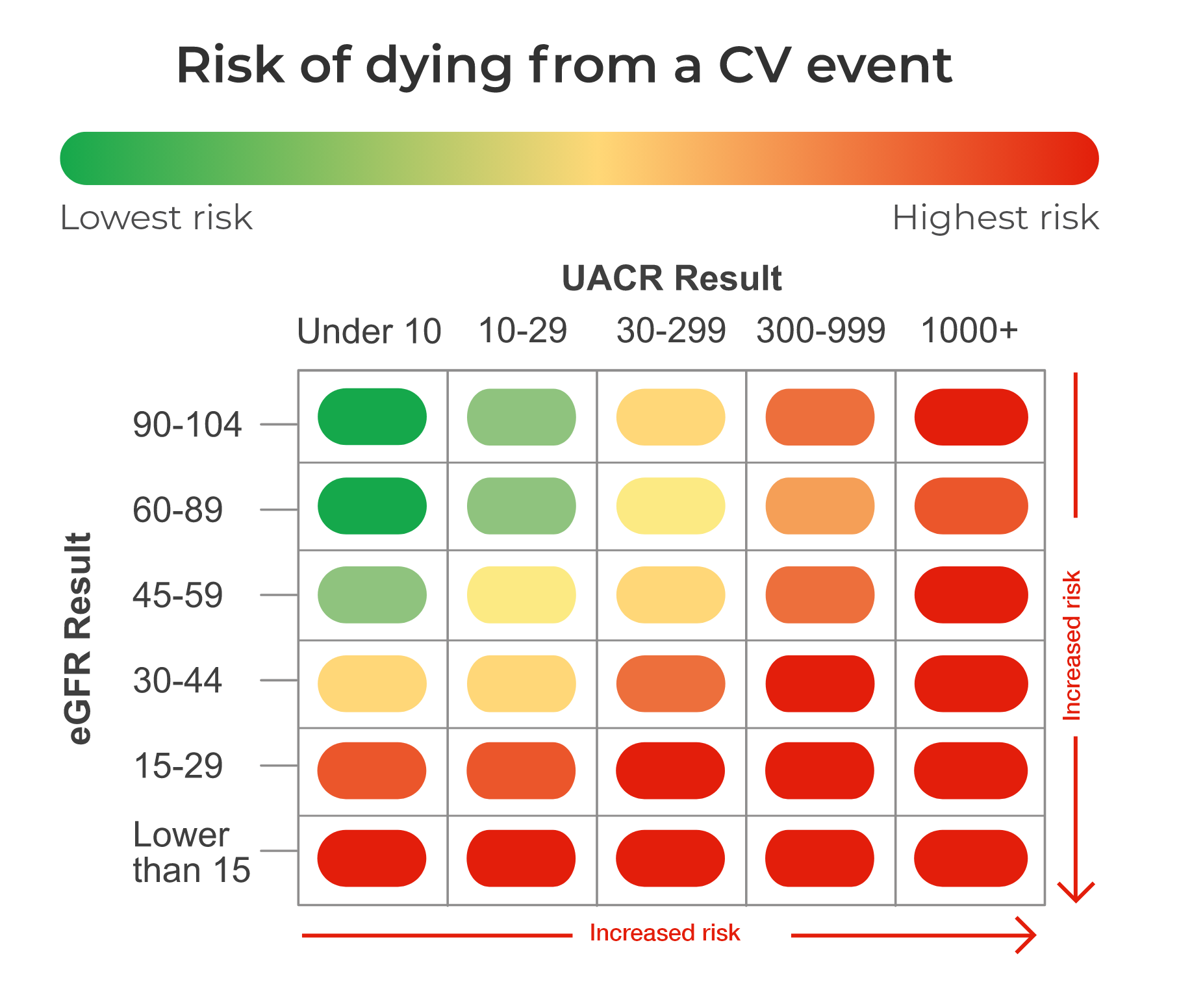
Using your UACR and eGFR lab results to predict CV risk

To use this chart, you will need your most recent UACR and eGFR lab results.Discuss where your UACR and eGFR results meet with your healthcare provider at your next visit.

UACR and eGFR result chart to predict the risk of dying from a cardiovascular event

Up down arrows icon

Your CV risk increases as your UACR increases and/or eGFR lowers

Ask your healthcare provider how KERENDIA can help with CKD in T2D

Download the Discussion Guide

Just starting KERENDIA or want to learn about resources?

Sign Up for Helpful Emails
See more + See less -

What is KERENDIA?

KERENDIA (finerenone) is a prescription medicine used to:

  • reduce the risk of worsening of kidney disease, kidney failure, death due to cardiovascular disease, heart attack, and hospitalization for heart failure in adults with chronic kidney disease (CKD) associated with type 2 diabetes (T2D) (10mg, 20mg tablets)
  • reduce the risk of death due to cardiovascular disease, hospitalization for heart failure, and urgent heart failure visits in adults with heart failure with left ventricular ejection fraction (HF LVEF) of ≥40%, when the heart may pump normally, but may not fill properly (10mg, 20mg, 40mg tablets)

Important Safety Information

Do not take KERENDIA if you:
  • Are allergic to any of the ingredients in KERENDIA
  • Take certain medications called CYP3A4 inhibitors. Ask your healthcare provider if you are not sure if you are taking any of these medications
  • Have problems with your adrenal glands
What are the possible side effects of KERENDIA?

KERENDIA may cause serious side effects, including:

  • High potassium levels in your blood (hyperkalemia). Your healthcare provider will check your potassium level before and during treatment with KERENDIA
  • Worsening of kidney function for patients with heart failure. Your healthcare provider will measure your kidney function before and during treatment with KERENDIA

The most common side effects of KERENDIA include hyperkalemia (potassium level in your blood that is higher than normal), hypotension (blood pressure that is lower than normal), and hyponatremia (sodium level in your blood that is lower than normal). Worsening of kidney function was also included in patients with heart failure.

Before you take KERENDIA, tell your healthcare provider about all your medical conditions, including if you:
  • Have high potassium levels in your blood (hyperkalemia) or take medications that may increase potassium levels in your blood
  • Have severe liver problems
  • Are pregnant or plan to become pregnant, or are breastfeeding or plan to breastfeed. Avoid breastfeeding during treatment with KERENDIA and 1 day after treatment
Tell your healthcare provider about all the prescription and over-the-counter medicines you take, including salt substitutes, vitamins, and herbal or potassium supplements.
  • KERENDIA may affect the way other medications work, and other medications may affect how KERENDIA works. Do not start or stop any medicine before you talk with your healthcare provider. Avoid grapefruit or grapefruit juice as it may increase KERENDIA levels in the blood

Please see the full Prescribing Information for KERENDIA.

Important Safety Information

Do not take KERENDIA if you:
  • Are allergic to any of the ingredients in KERENDIA
  • Take certain medications called CYP3A4 inhibitors. Ask your healthcare provider if you are not sure if you are taking any of these medications
  • Have problems with your adrenal glands
What are the possible side effects of KERENDIA?

KERENDIA may cause serious side effects, including:

  • High potassium levels in your blood (hyperkalemia). Your healthcare provider will check your potassium level before and during treatment with KERENDIA
  • Worsening of kidney function for patients with heart failure. Your healthcare provider will measure your kidney function before and during treatment with KERENDIA

The most common side effects of KERENDIA include hyperkalemia (high potassium level in your blood), hyperkalemia (potassium level in your blood that is higher than normal), hypotension (blood pressure that is lower than normal), and hyponatremia (sodium level in your blood that is lower than normal). Worsening of kidney function was also included in patients with heart failure.

Before you take KERENDIA, tell your healthcare provider about all your medical conditions, including if you:
  • Have high potassium levels in your blood (hyperkalemia) or take medications that may increase potassium levels in your blood
  • Have severe liver problems
  • Are pregnant or plan to become pregnant, or are breastfeeding or plan to breastfeed. Avoid breastfeeding during treatment with KERENDIA and 1 day after treatment
Tell your healthcare provider about all the prescription and over-the-counter medicines you take, including salt substitutes, vitamins, and herbal or potassium supplements.
  • KERENDIA may affect the way other medications work, and other medications may affect how KERENDIA works. Do not start or stop any medicine before you talk with your healthcare provider. Avoid grapefruit or grapefruit juice as it may increase KERENDIA levels in the blood

Please see the full Prescribing Information for KERENDIA.